
“I Can’t Keep Living Here”: The Memorial installed in the Heart of Amsterdam for a Hezbollah Terrorist - and the Outrageous Response from Authorities
Friends of the Hezbollah member installed a memorial in his honor in the Netherlands, while authorities refused to listen to Israelis in the city calling for its removal.
פורסם:
By Tomer Almagor
T., an Israeli who has lived in Amsterdam for about a decade, had nearly come to see himself as fully Dutch. He was deeply rooted in Dutch life, had bought a home, made friends, and planned to settle there long-term. But an innocent conversation in the WhatsApp group of the gym where he trained and coached changed everything.
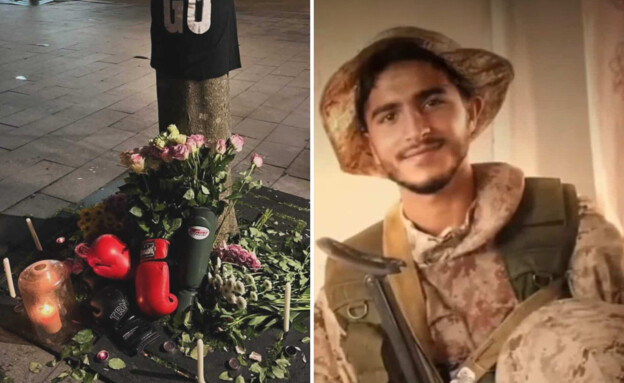
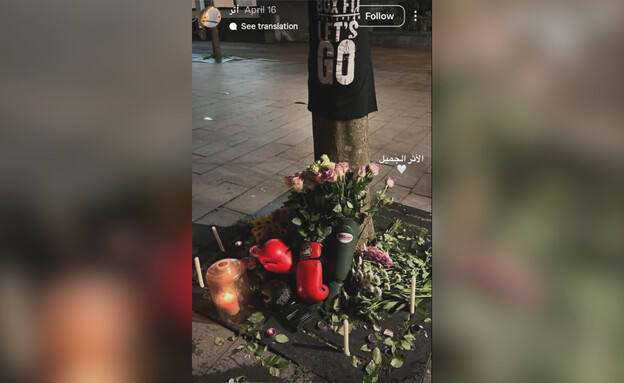
In the conversation, which he is sharing publicly for the first time with N12, the gym owner, a friend of T.’s, spoke about a young Lebanese man named Ali Diab, who had trained at the gym for some time and was allegedly killed in Lebanon by Israel. The owner even set up a memorial for Diab inside the gym and shared an emotional article from a popular Dutch media outlet mourning the loss of “a highly motivated young man.” At the same time, another memorial for Diab was placed at Museumplein in central Amsterdam, one of the most visited locations in the country – but something about the story did not sit right with T.
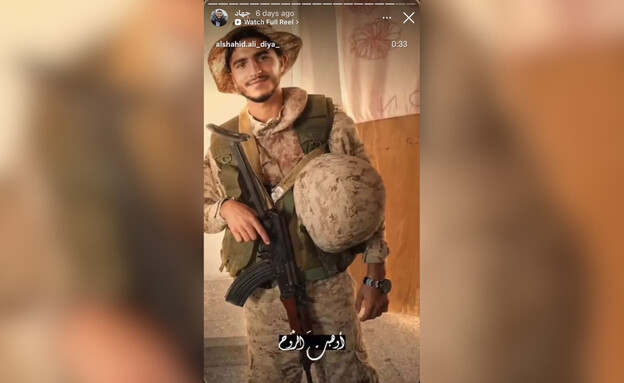
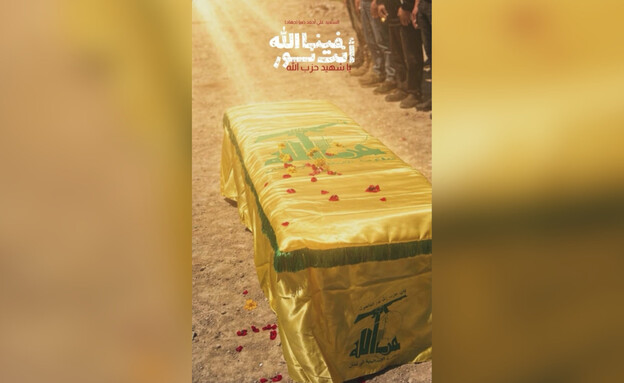
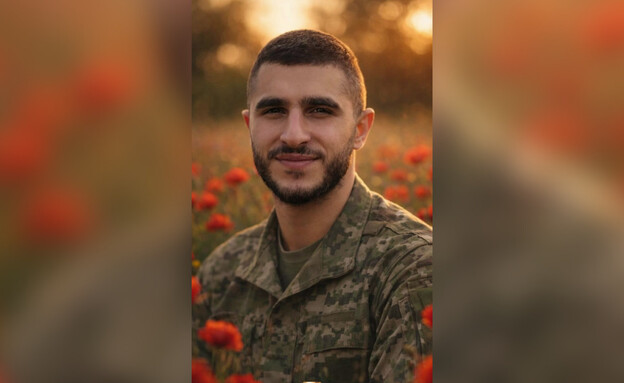
The Israeli decided to investigate further and quickly uncovered a very different story. Numerous signs and documented evidence indicated that Diab was in fact a Hezbollah terrorist, not an innocent young man unjustly expelled from the Netherlands and killed by Israel for no reason. On a public Instagram account, which Dutch media said was shared by Diab’s sister, he appears wearing military uniforms and carrying weapons. He was also featured in a memorial image with Hezbollah symbols and buried wrapped in a Hezbollah flag after being killed in the fighting in southern Lebanon.
The incident, and the authorities’ response to it (detailed below), caused T. and his wife to now consider leaving Amsterdam after ten years. “People here understand very well where things are heading. We’ve been intimidated enough to finally say: enough, we’re leaving. I don’t want to wait for something terrible to happen before deciding to leave. I’d rather recognize the warning signs and learn from them.”
פרסומת
The Appeal to the Municipality – and the Astonishing Response: “This Is a Free Country”
quickly contacted authorities regarding the public memorial to Diab, but despite filing a complaint with a municipal representative, nothing was done. After a week in which the memorial remained in place, he says he contacted them again, only to be told by the same representative that she had done nothing with the complaint.
The Dutch official went even further, saying she did not understand what was wrong with the memorial – despite the fact that the Netherlands officially designates Hezbollah as a terrorist organization. “It’s not clear for me (why it should be removed),” the representative reportedly said during the phone call. “This is a free country. Everyone can do what they want, and I don’t know the law you’re talking about.”
According to T., the representative refused to let him complete his report or escalate it to a superior manager, threatened to file a complaint against him, shouted at him, and added another disturbing statement: “This is exactly how these people do things to people living here in the Netherlands.”
פרסומת
“I felt like she was accusing me,” T. recalls. “I couldn’t understand why a city employee was trying to collect details about someone attempting to file a complaint. To me it was extremely serious, and I felt that there was an implied threat.” He later contacted Dutch police, who also disappointed him. According to T., one officer asked him why the memorial bothered him if he lived about a kilometer away from it.
“Most Jews in Amsterdam are living in fear and anxiety – they don’t know whether anyone would come to protect them. And when a memorial to a terrorist is presented as if it commemorates an innocent civilian, they realize not only that nobody will protect them, but that the authorities themselves are willing to distort reality in order to create a narrative portraying Israelis as perpetrators of genocide. That fuels the fire.”
Sympathetic Media Coverage Despite Evidence of Hezbollah Ties
Major Dutch media outlets also quickly adopted the narrative that Diab was a helpless young man killed by Israel. NRC, one of the Netherlands’ largest and most respected newspapers, published an in-depth profile of Diab without mentioning even once his ties to Hezbollah. He was described as “sweet, polite and somewhat shy” – a young man killed by Israel.
פרסומת
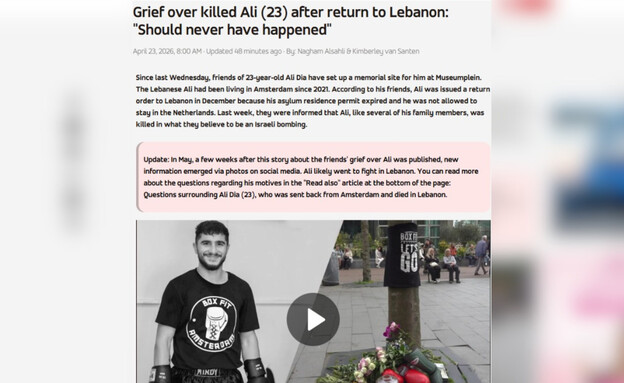
The local Amsterdam-focused outlet AT5 also published an article about “mourning the death of Ali (23), who was killed by a bomb after returning to Lebanon.” The article covered the memorial at Museumplein, described him as “young and motivated,” and criticized authorities for not allowing him to remain in the Netherlands. Additional articles were published about Diab, and the distorted narrative spread across social media.
contacted the outlet and informed them about Diab’s public ties to Hezbollah, but the article remained online. When N12 contacted the outlet anonymously with similar concerns, AT5 requested “additional information” proving that Ali was a terrorist. After receiving images of Diab armed and in military uniform, commemorated by Hezbollah, the outlet suggested the images might have been generated by AI.
Shortly afterward, the website published a follow-up article intended to “answer questions surrounding Ali Diab’s death.” The new piece acknowledged the existence of photos showing him as a Hezbollah fighter, but again claimed without evidence that it was unclear whether the images were authentic. In the very same article, Diab’s sister stated that he wanted “to resist the advancing Israeli army” and shared the same photos clearly indicating his affiliation with the terrorist organization – yet even that did not prompt the outlet to remove the original sympathetic article, apologize, or definitively state that he was indeed a terrorist.
The article even included the sentence: “The only thing that is almost certain is that Ali was killed in April in an IDF strike.”
פרסומת
When confronted by another Israeli about their refusal to apologize for publishing unverified information about a Hezbollah terrorist, the outlet replied: “We published an article about how his friends built a memorial for him and how they remember him. We have now published another article addressing the uncertainty raised by the Instagram page. How you interpret it is your decision, but we will not accuse someone of terrorism without credible evidence.”
In an interview with N12, AT5 deputy editor-in-chief Menko Arends said he did not regret publishing the article or feel any need to apologize. “His sister told us he was not a Hezbollah member, but that he fought, and perhaps did so with Hezbollah. We’re not sure about that; there are many questions to ask,” Arends explained.
“There was a memorial for him in the street. We asked what had happened, and we were told he had lived in Amsterdam for several years and was a good guy,” he added. “I understand that you and others in Amsterdam may see this as a journalistic failure – I see it differently.”
According to Arends, he was unaware of the evidence strongly indicating Diab’s ties to Hezbollah when the original article was published, and even after reviewing the evidence, he was not fully convinced Diab was a terrorist.
פרסומת
Following the interview, several minor edits were made to the articles. Among them, the original article clarified that “Ali apparently went to fight in Lebanon,” while the follow-up article softened the certainty that he had been killed by the IDF.
“It Breaks My Heart”
says he was forced to encounter the memorial to Diab at his own gym and eventually canceled his membership after the gym manager, with whom he had previously been close friends, refused to remove it. “Our friendship was over. It breaks your heart. We see what’s happening, and we all know what’s going on in Europe right now. But when it hits so close to home, It hurts deeply.” He said that seeing Diab portrayed in the media as an innocent victim without proper fact-checking “put him in shock.”
“It’s legitimate to criticize Israel,” he stressed, “but taking a terrorist and presenting him as an innocent civilian is not just a lie – it’s a manipulative attempt to sway public opinion against Israel.”
פרסומת
Following the series of events, T. reached out to the “Magen David Kachol” project, which provides legal assistance to Jews in Europe experiencing antisemitism. He hopes the legal process will raise awareness about what is happening in Amsterdam and lead to the removal of the memorial as well as legal action against the municipality, the gym, and the media outlets involved.
The project operates under the Department for Combating Antisemitism at Israeli Community Europe and works alongside the European Jewish Association, which represents hundreds of Jewish communities across the continent.
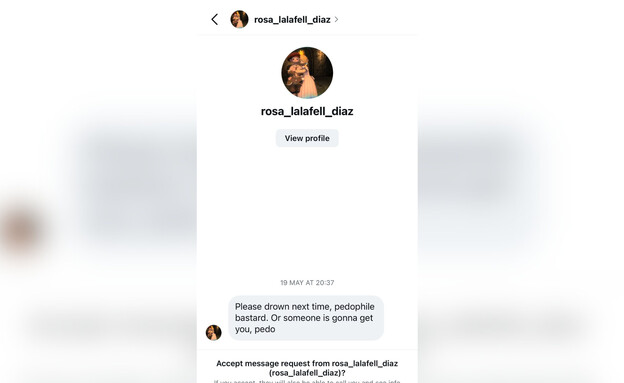
After weeks of pressure and inquiries from N12 and members of the Jewish and Israeli communities, the memorial has now been removed from Museumplein. However, after exposing Diab’s true identity online, T. began receiving serious death threats. “Please drown, pedophile bastard, or someone is gonna get you, pedo” one message read. At the same time, people close to him were also contacted in attempts to locate him.
T. says he is now considering a step that until recently seemed unimaginable: leaving the city he considered home for the past decade. “Because of this incident, together with many others we’ve heard about before, my wife and I are considering leaving the Netherlands. We’re already preparing and trying to decide where to move. This is part of a broader atmosphere and hatred toward Israelis,” he says painfully.
“Until now I had my concerns. Every incident like this hurts deeply and pushes us a little further out of the Netherlands. We need to sell our apartment, our whole life is here. We built a future in the Netherlands, and I had started to see myself as Dutch. That’s one of the things that hurts the most. I’m not leaving because I don’t want to live in the Netherlands anymore – I’m leaving because I probably can’t continue living here.”
The Amsterdam municipality did not respond to requests for comment.
מצאתם טעות לשון?