

After blocking EU moves against Israel and criticizing Europe’s progressive left, Czechia has become one of Jerusalem's last allies. In a special interview, the Deputy PM explains standing by Israel and claims: "There are countries in Europe that are more or less Islamist"
פורסם:
By Tomer Almagor
EU foreign ministers gathered this week in Brussels, in one of the continent's most important and influential forums, to discuss a long series of issues facing Europe – with the issue of sanctions against Israel at the center of their discussion. But Petr Mačinka, the Foreign Minister of the Czech Republic, was absent. Instead, Mačinka chose to come to Israel for an economic summit and to echo once again Czechia's clear line in recent months: we will protect Israel in the European Union and thwart any initiative to try and impose additional sanctions on it.
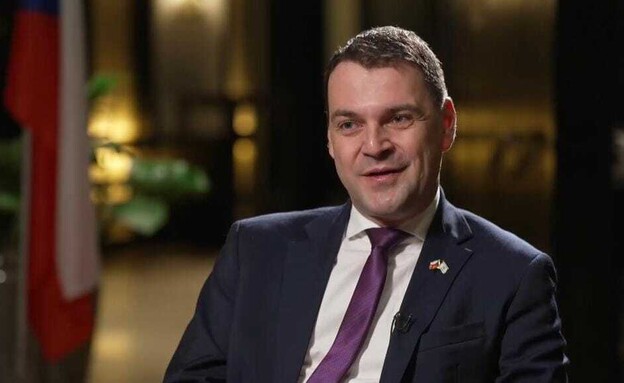
In an exclusive interview with N12, Mačinka calls some of the European countries hostile to Israel "Islamist," reveals the pressure exerted on Czechia to change its positions toward Israel, and clarifies: "I think we are not alone with this position. Maybe we are a bit more brave to say that".
Czechia's surprising declaration: "We will not allow sanctions"
For many years, Hungarian Prime Minister Viktor Orbán, an almost solitary voice, protected the Israeli government from sanctions in the European Union. Other allies, such as Germany and Italy, also assisted – but Orbán's automatic veto was unique and invaluable. After Orbán's downfall in the elections, Hungary changed direction, and Israel feared that without its allies' protection, the EU would now finally be able to implement the sanctions it had planned for years.
But then Czechia entered the picture. Mačinka, who also serves as Deputy Prime Minister, visited Israel in May and surprised many with a dramatic political statement: "We will not allow more sanctions against Israel in the European Union – even if it means we have to block them alone".
פרסומת
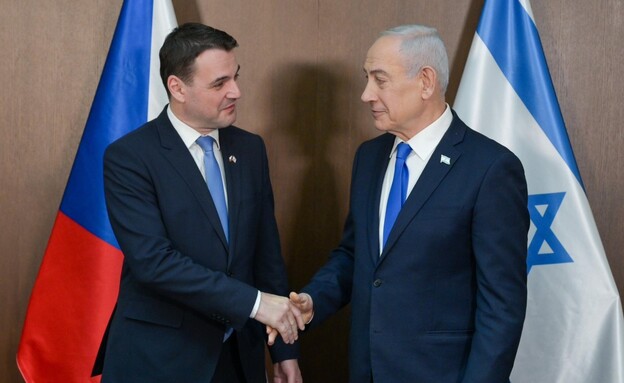
At our meeting this week at the Dan Hotel in Tel Aviv for the interview, Mačinka explains his extraordinary decision to protect Israel. "It's quite difficult for us to raise any sanctions and to discuss how to punish Israel for behaving in a way that is not according to the politically correct and progressive way of thinking of some European leaders," says the Czech Foreign Minister.
"I don't understand the positions of some countries in Europe – maybe they are more or less Islamist"
Mačinka clarified that he "refuses isolating the democratic partner with sanctioned diplomacy" and clarifies that the comparison made in Europe between Israel and other countries is, in his view, "crazy". "We all saw what happened on October 7th. We all see that Israel is surrounded by Hamas, Hezbollah, the Muslim Brotherhood, and all these crazy people, These are terrorists. You have the right to defend your country and I don't understand positions of some countries. Maybe these are more or less Islamist countries in Europe. But the Czech Republic is different," he says.
פרסומת
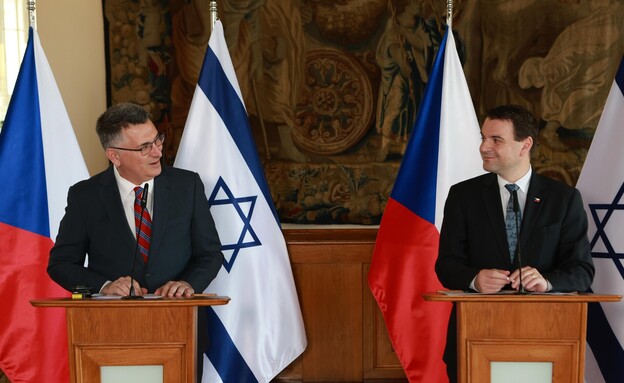
"Of course we pay a political price for it"
Czechia's support for Israel is like a bone in the throat for many countries in the Union, from Ireland to Spain, which have placed sanctions against Israel at the top of their political agenda. Prague has a long list of interests in Europe, and its support for Israel could complicate Czechia's position with other countries.
"Of course we pay some political price for that, but I don't care," Mačinka clarifies in our conversation, adding that despite the pressures, he remains firm in standing by Israel: "Some of them [ministers] ask me whether we could at least abstain... I respect their position, but they must respect the Czechia's position".
פרסומת
Mačinka also clarifies that Czechia is not Israel's only friend in Europe, saying: "I think we're not the only ones holding this position. Maybe we're simply a little braver to say it out loud. And when you say 'enough, no more sanctions,' then other countries, perhaps less brave to take the initiative themselves, join you."
Sharp criticism of Minister Ben-Gvir
In recent weeks, mainly following the violence in Judea and Samaria toward Palestinians and the video uploaded by National Security Minister Itamar Ben-Gvir with the bound detainees from the Turkish flotilla, European countries' efforts to impose sanctions on Ben-Gvir and Smotrich have increased. The ministers, and especially Ben-Gvir, have drawn sharp condemnations from dozens of Western countries, and a number of countries have decided to impose sanctions on them and ban their entry.
פרסומת
Mačinka himself sharply criticized Ben-Gvir in an interview with Bloomberg, calling him a "terrible and unbearable person" whose behavior "really crosses every line". In his conversation with us, he says he even made it clear to the Israeli government that he is not interested in meeting the ministers.
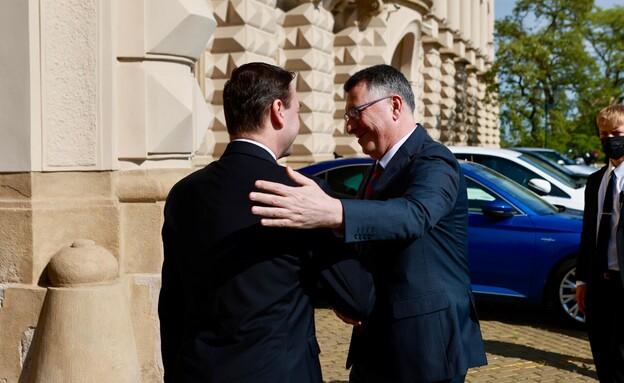
Despite this, Czechia strongly opposed sanctions against them in the Union and thwarted the effort supported by a decisive majority of countries on the continent. In our conversation, he explains his decision: "I don't want to see that someone is misusing the situation because he doesn't care being on the list or not. But he can say, 'Well, I'm a victim of some crazy evil EU anti-Zionist conspiracy,' which is definitely not the truth, but I don't want to be part of the story".
פרסומת
He added that in his view, imposing sanctions on politicians is "unbelievable and unacceptable," and that he does not want to assist them in elections or interfere in the elections in Israel.
"We don't want to export false morality"
Under the current government, Czechia has tightened its relations with Israel on a wide range of issues. This week, Foreign Minister Gideon Sa'ar and the Foreign Minister of Czechia opened the business forum between the countries and signed a joint declaration intended to deepen economic, political, and technological cooperation between the countries.
פרסומת
"Our top priority in foreign policy is economic diplomacy because we don't want to export false morality. That was probably the agenda of the previous, progressive government. We want to return to focusing on national interests," Mačinka says.
He adds that Israel is "probably our most important partner in the Middle East," and noted positively the close connection between him and Foreign Minister Sa'ar. "There are many ties between us, and we believe they can be further deepened and strengthened," said the Czech Foreign Minister.
The attack on the left in Europe: "We have already seen how it can end"
The Czech government, led by Babiš and Mačinka, has become one of the sharpest critics of the progressive left in Europe. In the interview, the Foreign Minister tells us about the trend he identifies on the continent, saying that the progressive left "definitely became a mainstream" but that there is also "a strong opposition" to it.
פרסומת
According to him, in Czechia there is a hypersensitivity regarding any trend or tendency against freedom and liberty, due to the country's Soviet background. "In Western Europe, they don't have such an experience. We have this experience, and therefore we are like a warning sign that says: This is not good – and we have already seen how it can end".
Mačinka also refers to the rift between Europe and the US, which is rocking the NATO alliance. The Czech government chose to move closer to Washington, while most of the European continent is moving in the opposite direction. "I just returned from the NATO summit that took place last week in Ankara, and there were many questions whether the US is leaving NATO. So, my answer after returning from the summit is: absolutely not. It's only reshifting the positions but I think it will make NATO stronger. America is still present, and plays a dominant role and I think Europe is capable enough to strengthen itself," Mačinka says.
The last topic in the interview was Mačinka's commitment to move the Czech embassy to Jerusalem, a commitment he gave at a Hanukkah candle-lighting event in Prague. "I don't like the silence around this topic. It’s certainly not a simple task, and it cannot be done overnight. But I think it might be a good momentum and maybe some good memorial to do it one day," says Mačinka, expressing hope that he will do so during the current term of the Czech government.
מצאתם טעות לשון?